Ghost Forests: Reading a Changing Chesapeake
Drive the back roads of Dorchester County and, here and there along the marsh, you'll pass a stand of bare, silvered tree trunks standing in the open grass — leafless, weathered, oddly beautiful and a little haunting. These are "ghost forests," and they're not the work of fire or storm but of salt. They mark, quietly and unmistakably, where the sea is creeping into land that was once dry forest. For a thoughtful traveler, they're one of the most honest and moving things to notice on the low-lying edge of the Chesapeake — a landscape telling you, in wood and salt, that it's changing.
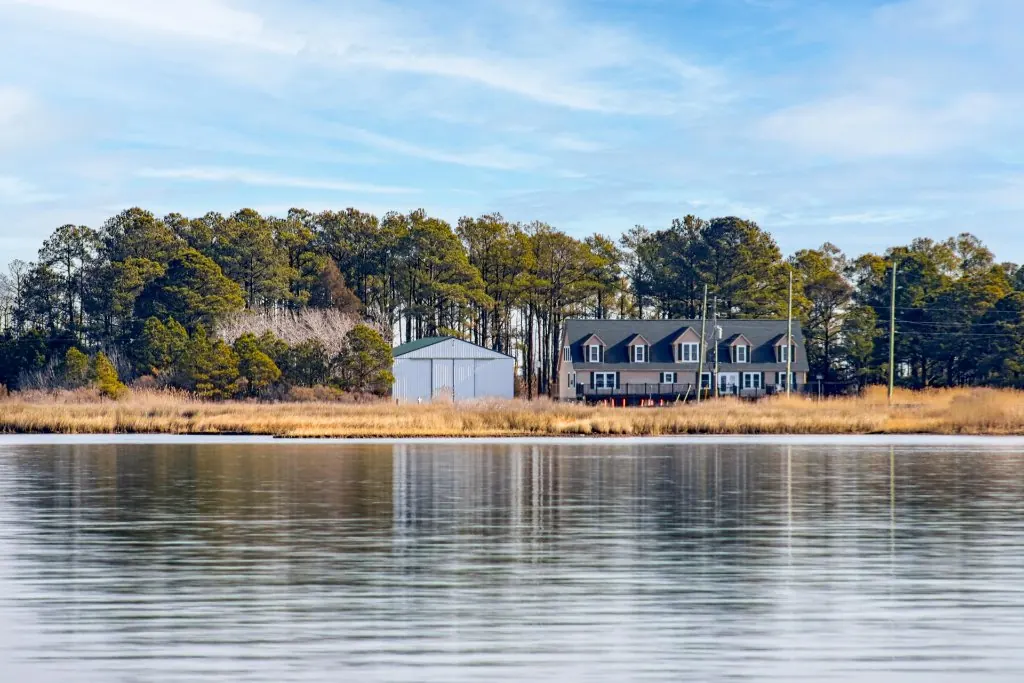
What a ghost forest is
A ghost forest is a stand of standing dead trees — often coastal species like loblolly pine and cedar — killed where saltwater has moved into ground that used to be fresh. As the trunks lose their bark and bleach pale in the sun and weather, they take on a bleached, skeletal look against the green marsh, which is where the name comes from. Ecologists describe them as a visible boundary in motion: typically you'll find dead trees sandwiched between the living forest on slightly higher ground and the open salt marsh on lower ground, marking the exact zone where one is giving way to the other. They appear across many low shorelines of the Chesapeake, and Maryland's lower Eastern Shore — including Dorchester County — is one of the places they're most striking.
How salt kills a forest
The mechanism is slow and mostly invisible. As sea level gradually rises, saltwater pushes farther inland — up creeks and guts, and into the groundwater beneath low, flat land. Trees that are adapted to fresh water can't tolerate the salt: it stresses and eventually kills them, essentially poisoning them from the roots. Researchers sometimes call this creeping saltwater intrusion an "invisible flood," because the damage can advance without any dramatic inundation — the water simply seeps in below the surface until the trees die standing. A single strong coastal storm that drives salt water inland can accelerate the process, finishing off trees already under strain. Once the forest is gone, salt-tolerant marsh grasses often move in behind it, and forest becomes marsh.
Why they matter here
Ghost forests are more than an eerie roadside curiosity — they're one of the clearest field signs of how a low-lying coast responds to rising seas, and the Chesapeake region is recognized as among the more vulnerable areas in the country to sea-level rise. Scientists study these dying stands to understand the pace of change and how coastal ecosystems shift from forest to marsh, and eventually, in some places, from marsh to open water. Around Dorchester — a county that is famously flat, marshy, and close to sea level, home to Blackwater National Wildlife Refuge — the transformation is especially legible. To stand near a ghost forest is to see, plainly, a process that maps and charts can only describe.
Where you might see them
You don't have to hunt for ghost forests here; you'll likely notice them simply by keeping your eyes open as you explore the county's marsh-lined roads. A few ways to encounter them thoughtfully:
- On drives through the low marsh country of Dorchester County, watch the tree lines along the marsh edge for pale, bare trunks standing apart from the living woods.
- A visit to Blackwater National Wildlife Refuge (about 19 miles away) offers a broad look at this shifting forest-to-marsh landscape, and the refuge is a place where the effects of rising water are openly discussed and interpreted.
- Come at low, warm light — early or late in the day — when the bleached trunks catch the sun and the scene turns genuinely photogenic, if wistful.
Whenever you stop, do it respectfully: stay on public roads and lands, don't trespass onto private property, and treat these places as the living, changing landscapes — and often the homes and heritage of local families — that they are.
Get $100 toward your first booking
Create a free Bayside Rewards account and we'll drop $100 toward your first direct booking — sign in when you check out and the $100 comes off there. Then earn 8% back on every stay after that.
Seen with respect
It's worth holding two things at once. Ghost forests are genuinely beautiful — stark, quiet, sculptural — and they are also a sober reminder of real change affecting a real, inhabited place. Hooper's Island and the surrounding county are home to working watermen and families whose lives are woven into this landscape, and the same low elevation that gives the area its wide skies and sweeping water views also makes it a front line for a changing coast. To visit here is to be a guest in a place that is, in a very literal sense, on the edge — and there's a kind of privilege in getting to witness it honestly.
A deeper way to experience the Bay
Not every memorable moment of a Chesapeake trip is a sunset or a crab feast. Some are quieter and more thought-provoking — a stand of ghost trees against the marsh, and the story it tells about water, land, and time. Understanding what you're looking at turns a passing glimpse into something you carry home. It's part of what makes a stay on this remote, low-lying island more than a getaway: a chance to see one of the country's great estuaries as it truly is, and to appreciate it all the more for its fragility.