Brown Pelicans on the Chesapeake: A Comeback Heads North
A generation ago, seeing a brown pelican on the Chesapeake would have been a genuine surprise — these were birds of the Gulf and the southern Atlantic, not the mid-Bay. Today they're part of the summer scene, gliding low in single file over the waves and folding into spectacular dives just offshore. Their arrival here is a quiet good-news story, one that rhymes with the ospreys and eagles you already watch. Here's the pelican's tale, and where to look for one.
Unmistakable, once you see one
There's no mistaking a brown pelican. It's a big, heavy-billed seabird with a wingspan that makes an osprey look modest, and that famous throat pouch slung beneath a long bill. In flight they're pure grace despite the bulk — gliding just above the surface in tidy lines, riding the cushion of air off the waves, barely beating a wing. Watch a string of pelicans skim a summer Bay and you'll see why they've been a favorite of coast-watchers forever.
The plunge-dive
The showstopper is the hunt. Brown pelicans are among the very few pelicans that fish by plunge-diving: a bird spots fish from the air, angles over, and crashes bill-first into the water from height, throat pouch ballooning open to scoop up both fish and a great gulp of seawater. It then tips its bill down to drain the water before swallowing the catch. The dive is sudden and dramatic — a white splash out of nowhere — and once you've seen one you'll keep scanning the water hoping for the next. They feed on the same kinds of small schooling fish that power the rest of the Bay's food web.

A comeback, like the ospreys and eagles
The pelican's story will sound familiar if you know the Bay's raptors. In the mid-20th century, brown pelican numbers crashed under the pesticide DDT, which thinned their eggshells so badly that nests failed — the same catastrophe that nearly wiped out ospreys and bald eagles. The bird was listed as endangered in 1970, DDT was banned in the U.S. in 1972, and the pelicans slowly recovered and began pushing their range northward. They were removed from the endangered species list in 2009. Their expansion into the Chesapeake is part of that rebound — a top-of-the-food-web bird returning as the poison worked its way out of the system.
Summer seabirds on the mid-Bay
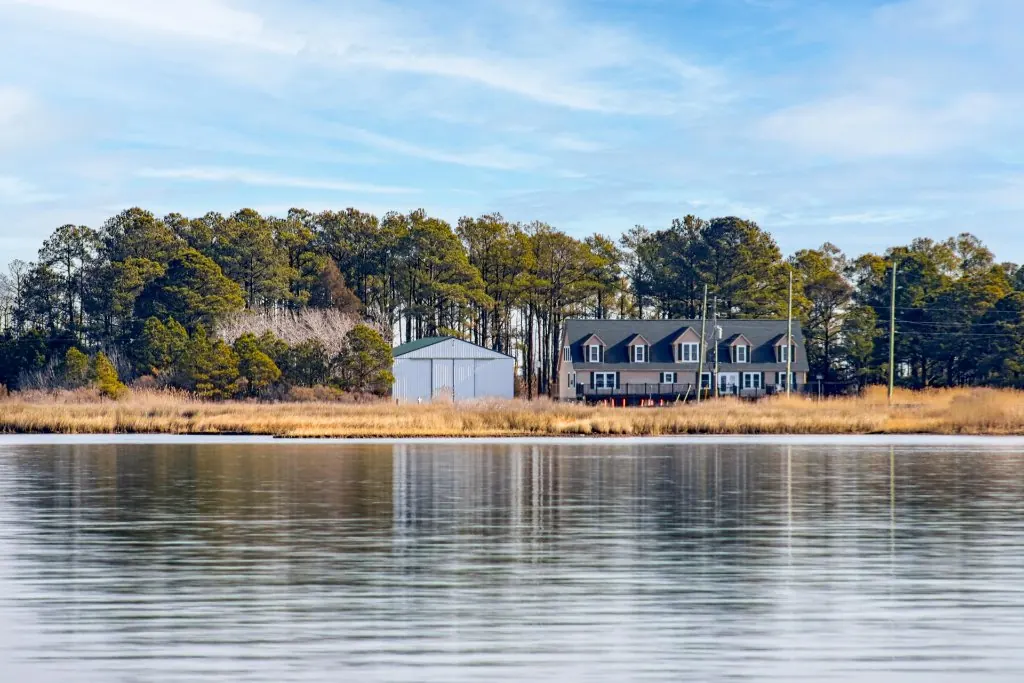
The Bayside Escape looks out over the open Chesapeake in Fishing Creek, MD — bring binoculars and watch the water. Create a free account and get $100 toward your first direct booking.
Where you might spot one
Brown pelicans are a warm-season visitor here, most likely from late spring through summer, and they favor the open, salty water of the mid and lower Bay. Remarkably, they now nest on marshy islands not far from Hooper's Island — colonies have established between Smith Island and Holland Island, which is about as far north as brown pelicans currently breed on the East Coast. That makes our stretch of the Bay genuinely good pelican country in summer. To look for them:
- Scan the open water and the horizon for low, single-file lines of large birds gliding over the waves.
- Watch for the splash — a plunge-diving pelican is visible at a distance.
- Check pilings, markers, and sandbars, where pelicans like to loaf and rest between feeds.
- Get out on the water if you can — a boat or paddle on a calm day improves your odds.
No promises — but keep watching
As with all wildlife, a pelican sighting is a hope, not a guarantee; some summer days the Bay is full of them and others they're nowhere to be seen. But the very fact that you might see one from a Hooper's Island shoreline is worth savoring — a bird that vanished from much of the coast, brought back and moving north, now diving in waters where a lifetime ago it simply wasn't. Add it to the eagles, ospreys, and herons, and you've got a Bay writing one of conservation's better chapters, right in front of you.